1.7 release notes
Release scope, components, and entry points for 1.7.0.
KubeClipper manages the Kubernetes cluster lifecycle, including creation, scaling, upgrades, backup, recovery, and deletion, through a web console, API, and the kcctl CLI.
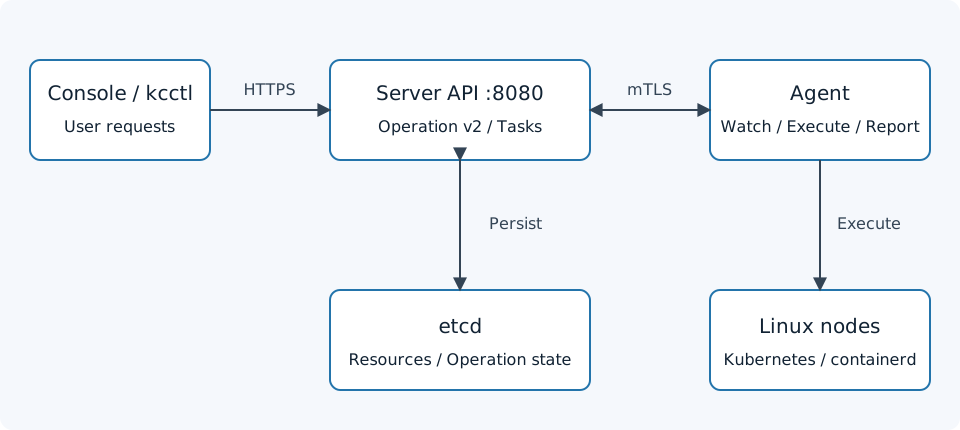
1.7 uses API-driven Operation v2 rather than built-in NATS task delivery. Operations run asynchronously. Confirm results using Operations, cluster state, and the actual nodes. See operations and logs.
| Purpose | Default port | Clients |
|---|---|---|
| Console | TCP 80 | Browsers; configure HTTPS at the production entry point |
| Server API | TCP 8080, HTTPS | kcctl, Console, Agents |
| Resource file service | TCP 8081 | Nodes downloading resources |
| Platform etcd | TCP 12379 / 12380 / 12381 | client / peer / metrics; restrict to the management network |
| Agent task logs | TCP 10260 | Server to Agent; restrict access for the actual configuration |
| SSH | TCP 22 | Deployment and node maintenance |
Deployment configuration can change these ports. Check Agent task-log listener configuration against firewall rules as well; older NATS port lists do not apply.
--ip-detect selects the platform management address. --node-ip-detect selects the Kubernetes node address. Check connectivity explicitly on hosts with multiple interfaces. Pod network address detection belongs to the selected CNI configuration.
Release scope, components, and entry points for 1.7.0.
KubeClipper 1.7 capabilities.
KubeClipper Roadmap