This is the multi-page printable view of this section. Click here to print.

Return to the regular view of this page.

Overview

Components and networking in KubeClipper 1.7.

KubeClipper manages the Kubernetes cluster lifecycle, including creation, scaling, upgrades, backup, recovery, and deletion, through a web console, API, and the kcctl CLI.

Architecture in 1.7
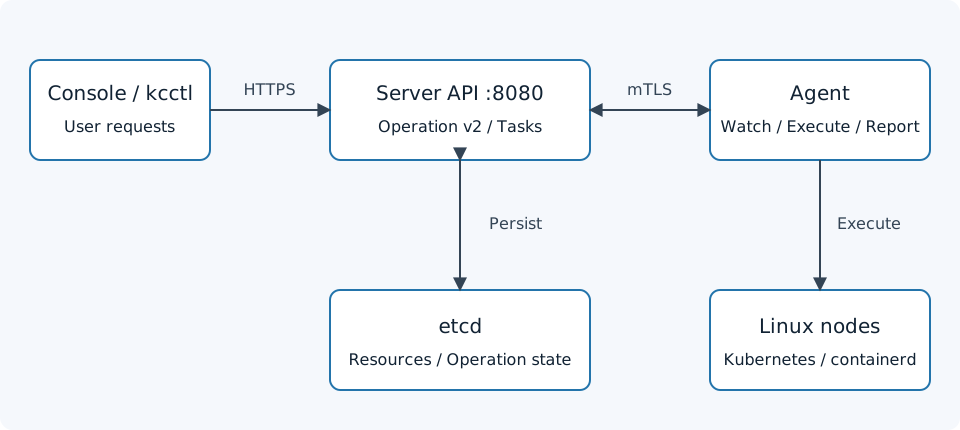
KubeClipper Operation v2 architecture

  • kc-server serves the API and persists clusters, Operations, and Tasks. Controllers advance their state.
  • kc-agent runs on managed nodes. It accesses the Server API over mTLS, watches assigned tasks, executes them, and reports results.
  • kcctl / Console submit management requests and display platform health, progress, and logs.
  • etcd stores platform resources and state. Plan platform etcd separately from the etcd clusters used by managed Kubernetes clusters.

1.7 uses API-driven Operation v2 rather than built-in NATS task delivery. Operations run asynchronously. Confirm results using Operations, cluster state, and the actual nodes. See operations and logs.

Networking

PurposeDefault portClients
ConsoleTCP 80Browsers; configure HTTPS at the production entry point
Server APITCP 8080, HTTPSkcctl, Console, Agents
Resource file serviceTCP 8081Nodes downloading resources
Platform etcdTCP 12379 / 12380 / 12381client / peer / metrics; restrict to the management network
Agent task logsTCP 10260Server to Agent; restrict access for the actual configuration
SSHTCP 22Deployment and node maintenance

Deployment configuration can change these ports. Check Agent task-log listener configuration against firewall rules as well; older NATS port lists do not apply.

--ip-detect selects the platform management address. --node-ip-detect selects the Kubernetes node address. Check connectivity explicitly on hosts with multiple interfaces. Pod network address detection belongs to the selected CNI configuration.

Start here

1 - 1.7 release notes

Release scope, components, and entry points for 1.7.0.

This documentation targets KubeClipper v1.7.0, released on September 8, 2026. See the official v1.7.0 release.

Main changes

  • API-driven Operation v2 manages operations, tasks, and execution state. Agents communicate with Servers over mTLS.
  • kcctl operation provides lists, details, logs, retries, and cancellation.
  • kcctl status and kcctl doctor report platform health and diagnostic evidence.
  • Registry resources select Kubernetes image repositories and configure containerd image pulls.
  • Deployment prechecks identify the node, role, and underlying error. Server installation waits for platform etcd health.

Component versions

KubernetescontainerdCalico
v1.37.02.2.4v3.31.5
v1.36.42.2.4v3.31.5
v1.35.82.2.4v3.31.5

Kubernetes v1.37.0 is the default. Available selections depend on platform resources; offline installations also need packages for the target CPU architecture. Source: v1.7.0 support matrix.

Release scope

This documentation describes v1.7.0. Review release notes, security advisories, and binary versions before production use. See the upgrade checklist.

The version menu preserves documentation for 1.6 through 1.1. The 1.6 documentation follows the v1.6.0 release tag.

2 - Features

KubeClipper 1.7 capabilities.

Cluster lifecycle

Create, delete, upgrade, back up, and restore Kubernetes clusters. Manage cluster nodes and import existing clusters. Online and offline installation support amd64 and arm64 resources; use the 1.7 component matrix when selecting versions.

Operations and troubleshooting

Operation v2 records asynchronous cluster changes. Inspect execution state and logs, then retry or cancel when appropriate. Operation commands and platform diagnostics help locate failures.

Image and resource management

Registry resources configure image sources and containerd pull settings. Offline packages provide component resources separately.

Platform and access

Deploy a single-node lab or a high-availability platform. Agents use mTLS to access the Server API. RBAC provides user permissions; see access control.

3 - Roadmap

KubeClipper Roadmap

This page records development directions, not capabilities guaranteed by v1.7.0. Consult the release notes for shipped functionality and GitHub issues for current discussions.

  • OCI-based distribution of installation resources
  • Kubernetes workload and monitoring views
  • Application and add-on lifecycle management
  • Additional managed-cluster deployment modes

No delivery dates are promised here. Validate experimental features separately before production use.